A Homeowner's Guide to Gutters for Manufactured Homes in Waldo
Waldo homeowners know how fast a calm afternoon can turn into a hard Florida rain. On a manufactured home, that shift matters. Water comes off the roof quickly, and if it has nowhere useful to go, it can splash against skirting, churn up bare spots in the yard, and leave puddles where you do not want them. A good gutter system is not glamorous, but it is one of those upgrades that quietly protects the home every time the weather turns.
That is especially true in this part of Florida, where summer thunderstorms, tropical systems, and heavy humidity keep drainage on the list of year-round home concerns. The basic job of gutters is simple: catch roof runoff and move it away from the home. The practical details are where homeowners usually get stuck, particularly with manufactured homes, metal roofs, tight lot lines, and outdoor spaces like patios or pool enclosures.
If you are sorting through options, comparing estimates, or trying to decide whether your current setup is good enough, it helps to think less about the gutter itself and more about where the water will go after it leaves the roof.
Why gutters matter more on a manufactured home
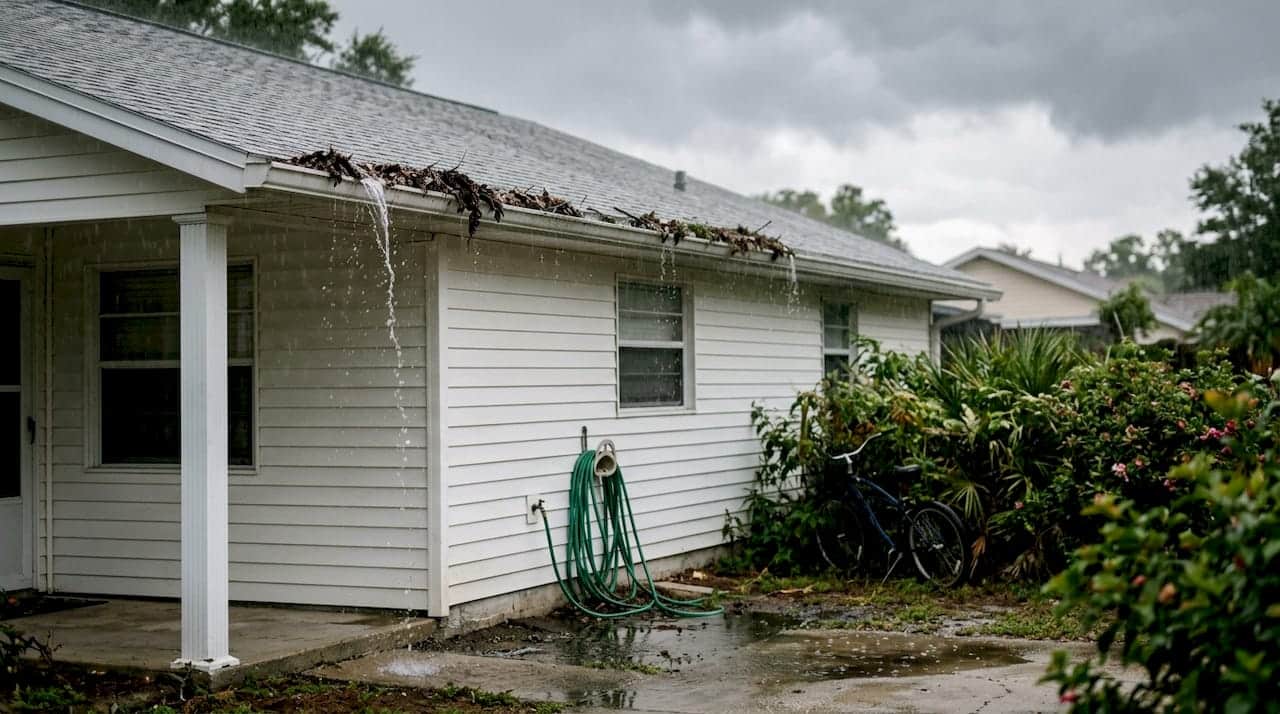
Manufactured homes often have features that make drainage more noticeable. Many have long roof runs, lighter exterior materials, skirting, and grading that does not always help water move away as well as it should. When runoff drops straight from the eaves during a hard storm, the impact can be stronger than people expect. You see trenching in mulch beds, muddy splashback on siding, and saturated areas near entry steps or utility connections.
Florida guidance on stormwater management consistently points in the same direction: keep roof runoff on site when possible, and direct downspouts into areas that can absorb water, such as lawn, planting beds, rain gardens, or other pervious spots. That advice fits manufactured homes very well. Even a modest gutter system can help turn uncontrolled runoff into something manageable.
Another reason gutters matter is simple comfort. Without them, sheets of water can pour off roof edges right where you walk, open a door, or step onto a small porch. That is not a structural crisis, but it does make the home harder to live with during the wet season.
The first decision is not style, it is drainage
Homeowners often start by looking at profiles, colors, and materials. Those things do matter, especially if the home is visible from the street or subject to association review. Still, the more important question is where each downspout will discharge.
Florida-friendly landscape guidance emphasizes reducing runoff and keeping water where it can soak into the property rather than rushing across hard surfaces. On a Waldo lot, that usually means sending downspouts toward turf or a planted bed, not toward the base of the home and not across an area that stays slick. Water that pools near a structure can create nuisance conditions and pest issues, so moving it away is the real goal.
That becomes even more important if your lot has one low side, compacted soil near driveways, or areas where water already stands after storms. Gutters cannot fix a yard-wide drainage problem by themselves, but they can stop the roof from making it worse.
Metal roofs change the conversation
A lot of manufactured homes in Florida have metal roofing, and homeowners often ask about gutters for metal roofs Florida contractors recommend. The concern is understandable. Metal sheds water fast, and in a strong rain the runoff can be intense. That does not mean gutters are a bad match. It means the system needs to be planned with runoff in mind.
In practical terms, metal roofs reward clean lines and secure attachment. Water will not politely trickle off during a summer downpour. It will move. That is why sloppy pitch, undersized discharge paths, or poorly placed downspouts tend to show problems quickly. If you have ever stood under a roof edge during a thunderstorm and watched water shoot off like a curtain, you already understand the point.
This is also where real-world judgment matters. A tiny porch roof may only need a simple setup to keep the entry dry. A long main roofline on a double-wide may need more attention because the water volume is very different. There is no single rule that fits every manufactured home.
What drives gutter installation cost factors Florida homeowners should know
People usually ask for a square-foot price and expect the answer to settle it. It rarely does. Gutter installation cost factors Florida homeowners deal with are more layered than that, and manufactured homes are no exception.
Length is the obvious factor. More roof edge means more material and labor. Height and accessibility matter too, even on homes that are not especially tall. A straightforward run with clear working space is easier than a side crowded by fencing, landscaping, utility lines, or attached structures. The number of corners, downspouts, and discharge points affects labor as much as raw footage.
Material choice can influence price, but so can how the pieces are made and installed. Many homeowners prefer seamless gutters because fewer joints usually means fewer places for trouble to start over time. If you have seen people search for seamless gutters Williston FL, that is the kind of product comparison they are often trying to make, even if they live elsewhere. The name of the town changes, but the question is the same: do I want fewer seams and a cleaner finished look? For many homeowners, the answer is yes.
Then there is the drainage plan itself. A simple install that drops water into open lawn is one thing. A layout that needs more careful routing because of walkways, skirting, garden beds, or enclosed outdoor structures is another. That planning may not look dramatic from the street, but it is often what separates a system that merely exists from one that actually solves a problem.
Color matters, but not as much as people think
Homeowners can get surprisingly hung up on finish choices. I understand it. Gutters sit at the edge of the roofline, which means they frame the home visually. The good news is that gutter colors for Florida homes do not need to become a design crisis. In most cases, people are happiest when the gutter either blends with the trim or quietly supports the roof color.
On manufactured homes, lighter neutrals tend to disappear best. Darker colors can look sharp if they tie into shutters, fascia, or roofing, but they also draw more attention to every line. If your home is in a community with appearance rules, check those before ordering. Florida law gives homeowners associations authority over exterior appearance standards, including colors and styles for certain exterior components, but those standards still have to comply with code requirements and cannot be used to block conforming installations outright. That does not remove the need for approval in some neighborhoods, but it does mean appearance review is not unlimited.
If you are torn, step back from the sample chip and think in larger shapes. Do you want the roof edge to disappear or stand out? Most manufactured home owners prefer disappear.
The downspout question nobody asks soon enough
A gutter is only as good as its exit strategy. I have seen systems that looked neat from the curb and still dumped water exactly where the homeowner did not want it. That is common near porches, carports, and screened spaces.
For homes with outdoor enclosures, gutter drainage for pool cages deserves special thought. Roof runoff and drainage around outdoor living areas need careful handling so water does not erode nearby soil or create messy overflows where people gather. Even if your setup is not a full pool enclosure, the same logic applies to screened patios and slab-adjacent spaces. You do not want a downspout emptying where it will undermine the edge of a pad, wash mulch into a walkway, or leave standing water that turns the area unpleasant after every storm.
The best discharge point is usually a pervious area that can absorb water without turning into a swamp. Turf and planting beds often work well. Sometimes a slightly longer run to a better outlet is worth it. A shorter path is not automatically the smarter one if it creates repeat problems.
Common gutter myths Florida homeowners still hear
Florida gets enough rain that bad advice does not stay harmless for long. A few myths come up again and again, especially with manufactured homes.
- “My roof overhang is enough, so I do not need gutters.” Overhang helps, but it does not control where heavy runoff lands.
- “Water in Florida soaks in fast, so drainage does not matter.” Some of it does, but intense storms can move water faster than the ground can absorb it.
- “If gutters are installed, they are basically done forever.” They still need cleaning, inspection, and occasional repair.
- “Guards mean I never have to think about gutters again.” Guards can reduce debris buildup, but they do not remove the need to check the system.
- “All gutter problems are roof problems.” Sometimes the roof is fine and the issue is simply clogs, poor discharge, or a damaged section.
Those are the kinds of gutter myths Florida homeowners often repeat because each one sounds partly true. The trouble is that partly true is enough to cost you a wet entry, soggy beds, or recurring overflow.
Cleaning, maintenance, and the real DIY decision
Gutters and downspouts need maintenance. Florida conditions make that non-negotiable. Leaf litter and debris build up, and when they do, drainage suffers. Water spills over where it should not. Debris can hold moisture. Downspouts clog. Small problems turn visible fast during the next storm.
That leads to the question every homeowner asks: DIY gutter cleaning or hire a pro? The honest answer depends on the home, the access, and your comfort with ladder work. Manufactured homes are sometimes lower and easier to reach than site-built homes, which can make owners underestimate the risk. The issue is not only height. It is footing, wet ground, awkward reach, power lines, and whether you can really flush and inspect the whole run safely.
If you are able to clean your own gutters, make the job about inspection as much as debris removal. You are looking for standing water, loose attachment points, joints that leak, and downspouts that do not discharge cleanly. If you are not steady on a ladder or the home layout makes access awkward, hiring out is money well spent.
Homeowners who search for gutter cleaning Dunnellon FL are usually doing the same thing homeowners in Waldo do, which is trying to compare the value of routine service versus handling it themselves. The principle is universal: cleaning is cheaper than neglect, and safe cleaning is cheaper than a fall.
When repair makes more sense than replacement
Not every failing gutter system needs to be replaced. Sometimes a section has pulled loose. Sometimes the problem is a clogged downspout, a joint leak, or a discharge point that was never ideal to begin with. Gutter repair Hawthorne FL is another one of those search phrases that points to a broader homeowner question: can this be fixed, or am I throwing money at an old system?
A good repair candidate is a gutter that still fits the home, still drains reasonably well when clear, and has a limited number of problem areas. A poor candidate is one with recurring overflow, widespread sagging, poor pitch across multiple runs, or a layout that sends water to the wrong places even when everything is clean.
This is where it helps to watch the system during a real rain if you can do so safely. Overflow at one corner tells a different story than spillover along an entire wall. If water reaches the downspout but then pools at the outlet, the gutter may not be the core issue at all. The home is telling you where the problem lives.
What about gutter guards?
Gutter guards Mount Dora FL is the kind of local search term people use when they are tired of cleaning and hoping for a permanent answer. Guards can help, especially where debris is a recurring issue, but they are not a magic shield. They reduce how much material enters the trough. They do not eliminate maintenance, and they do not solve poor pitch or bad drainage planning.
On manufactured homes, guards make the most sense when the homeowner already has a well-functioning system and wants to cut down on routine buildup. They are less useful as a bandage on a system that was poorly designed from the start. If the water has nowhere good to go, a cleaner gutter still will not fix that.
There is also a practical mindset piece here. If you install guards expecting to forget the gutters forever, you are setting yourself up for disappointment. If you install them expecting less frequent cleanout and easier upkeep, that is more realistic.
A year-round approach works best in Florida
Because Florida weather does not give gutters a true off-season, maintenance works better as a cycle than a once-a-year task. A year-round gutter checklist Florida homeowners can actually stick with should be short and practical.
- Check gutters and downspouts before the heaviest summer rain pattern sets in.
- Look again after major storms for clogs, loose sections, and discharge problems.
- Keep downspouts aimed at lawn or planted areas that can absorb runoff.
- Watch for pooling near the home, skirting, walkways, and outdoor living spaces.
- Address small leaks or loose connections before they become overflow points.
That is enough for most homes. You do not need a complicated spreadsheet. You need the habit of looking before and after rough weather.
Matching the system to the lot, not just the home
One mistake I see often is choosing gutters based only on the house elevation photo or a contractor quote sheet. The lot matters just as much. Two manufactured homes with the same roofline can need very different drainage plans because the surrounding grade is different.
A flat yard can hide trouble because water spreads slowly and lingers. A sloped yard can move runoff faster than expected and erode the receiving area. A narrow side yard may limit where a downspout can go without creating a soggy path beside the home. If there is a patio, screen room, or cage nearby, drainage becomes more than a yard issue. It becomes a livability issue.
This is why the best gutter conversations happen outside, not just over measurements. Walk the perimeter. https://gutterguardguide575.sagecurrent.com/posts/rainwater-drainage-planning-in-hawthorne-reducing-splashback-near-the-house Notice where the splash marks already are. Look at where mulch shifts after rain. Pay attention to the side of the home that stays wet longest. Those clues tell you more than a color chart or a catalog profile ever will.
The quiet payoff of a well-planned system
When gutters are working properly, you stop noticing them. That is the whole point. You get a drier entry, fewer muddy trenches, less splashback on the home, and a yard that handles storms with less drama. You also gain a little peace of mind during the weeks when Florida weather seems to arrive every afternoon with a bang.
For a manufactured home in Waldo, the smartest gutter decision is rarely the flashiest one. It is the one that respects how fast Florida rain falls, where your roof sheds it, and where your property can absorb it safely. Start there, and the choices about style, material, guards, and color get much easier.
Corrections
Spot something wrong? Send it to the desk and it gets fixed in the open.